Short answer: judge each source by what its visitors do after they land: how many add to cart, reach checkout and order. A source with fewer visits but more carts and orders is worth more than a busy one that only browses.
CartSpy ranks your traffic sources and UTM campaigns by carts, checkouts and orders, and shows the cart value each source brings, so the difference is visible on one screen.
A social ad can send a lot of visitors who look once and leave. An email to past customers can send a few who buy. Ranked by sessions, the ad wins. Ranked by orders, the email does. Ranked by carts, you also see the source that fills carts that then stall, which is usually a price, shipping or landing-page problem rather than a targeting one.
Shopify's analytics report sessions and sales by channel, referrer and UTM parameters. That answers "which source sells". It is harder to see, per source, the carts and checkouts that didn't turn into orders: the reports are built around sessions and completed sales.
Tag every paid link with UTM parameters (utm_source, utm_medium, utm_campaign) so each campaign is counted on its own rather than disappearing into "Facebook" or "Direct".
CartSpy is an app for Shopify that puts the traffic source on every add to cart, checkout and order it records. Its Analytics add them up per source and per UTM campaign:

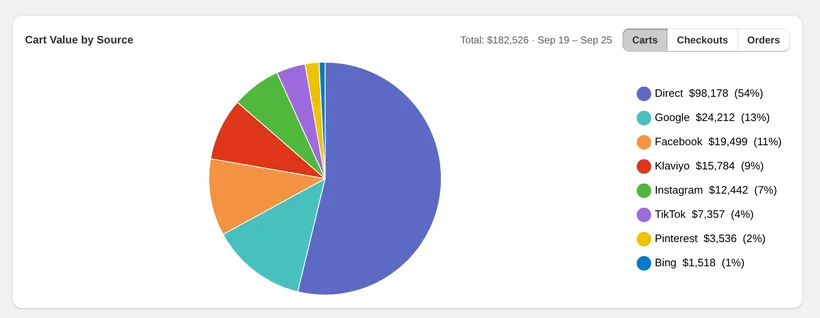
The same sources appear live: every card in the Live View carries the icon of the source that brought the shopper, and the daily email lists where yesterday's carts, checkouts and orders came from.
CartSpy doesn't import ad spend, so it doesn't calculate return on ad spend, and it doesn't do multi-touch attribution across several visits. If that is the question, an attribution app is the right tool; CartSpy answers the one before it: what the traffic did once it arrived. See the comparison with other kinds of analytics app. The listing: CartSpy on the Shopify App Store (apps.shopify.com/cartspy).
Compare each source by how far its visitors get: adds to cart, checkouts and orders, not just sessions. CartSpy ranks traffic sources and UTM campaigns by exactly those steps, with a rate for each.
Yes. Shopify reports sessions and sales by channel, referrer and UTM. What it doesn't list per source are the carts and checkouts that didn't become orders, which is where a source that brings browsers differs from one that brings buyers.
Look at that source's adds to cart and checkouts. Few carts means the visitors aren't interested in what they land on. Many carts but few checkouts or orders points at price, shipping or trust at the cart and checkout stage.
No. CartSpy shows the source and UTM campaign on each cart, checkout and order. It does not import ad spend, calculate return on ad spend or do multi-touch attribution; attribution apps do that.
Both. Essential ($7.99 a month) includes traffic sources and UTM campaigns; Advanced ($14.99 a month) keeps a longer history and adds all CSV exports.
Install, and every cart is tagged with where it came from. 7-day free trial, cancel any time.
Start free trial